
Location, Location, Location
The Kruger house stands alone
Written by Josef Woodard
Photographs by Alex Noble
One of the more intriguing dwellings in Summerland is hiding in plain sight—if you’re a beachcomber walking along the coast north of Lookout Park. Gazing upward toward the railroad tracks, you’ll notice the dreamlike vision of an elegantly rustic structure perched close to, but high above, the sand and water.
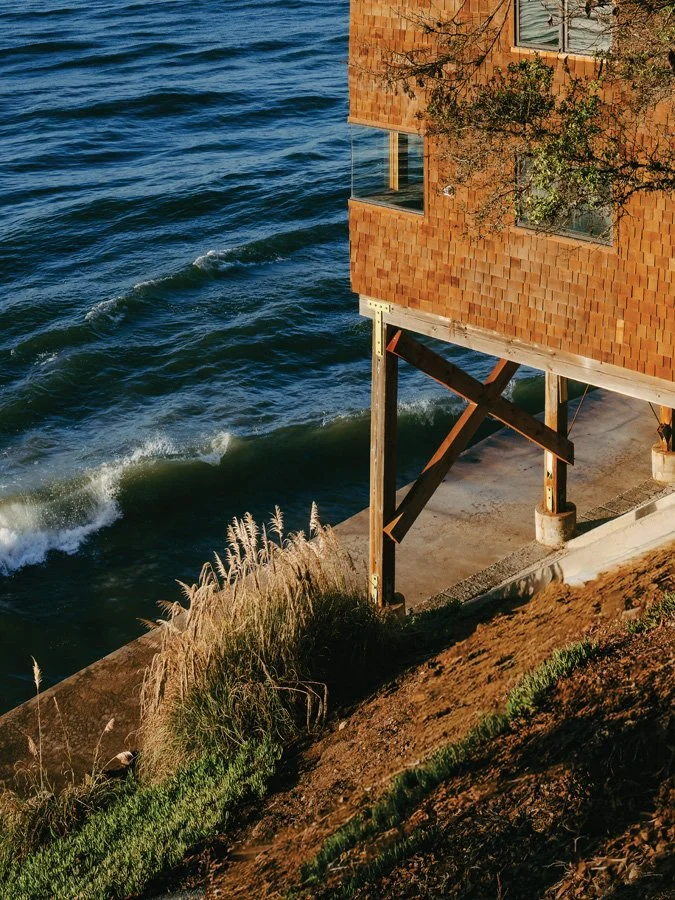
The redwood of the house is striking against the ocean background.
“We wanted to stay true to the original vision and bring it into today but not lose what makes it special.”
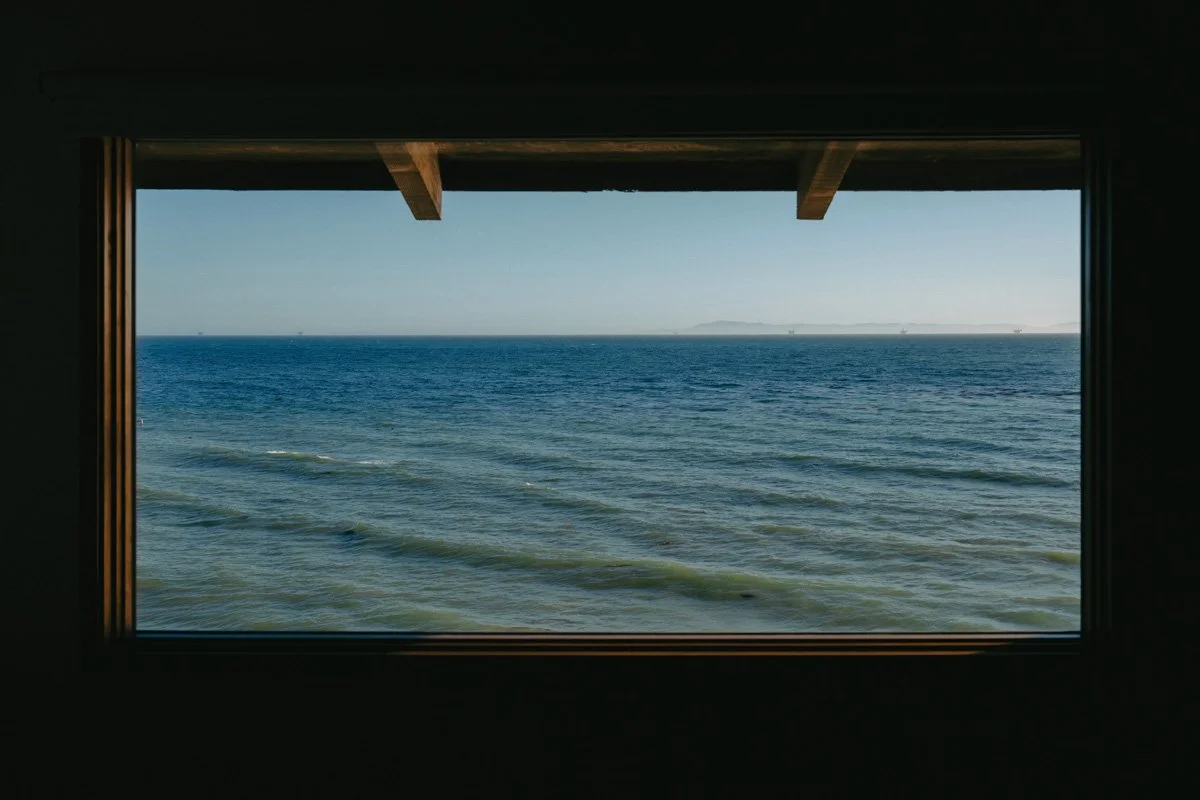
Unique and isolated from the local coastal neighborhood, the dwelling, actually a duplex, was built by Santa Barbara architect Kenneth Kruger in 1971. It remained in the Kruger family until 2018, and new owner J. P. Knapp finished a renovation of its Unit B in 2025. The dwelling is fairly small—a large living room blending into a kitchen, with two small bedrooms upstairs. But the most dramatic feature is an enveloping ocean view, with a “you are there” impact visible from every room, especially on the ample deck.
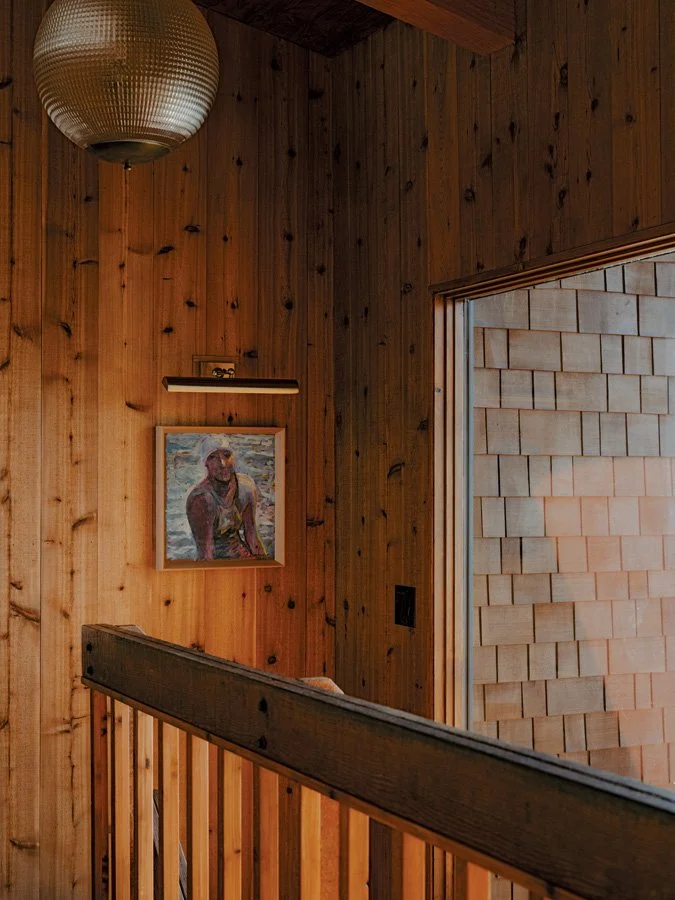
The upstairs atelier showcases the contrast of cedar interior walls and the shingled exterior.
Stylistically, the design resembles 1970s funky chic with echoes of Northern California architecture common to the dwellings in Sea Ranch: dark wood-shingle exteriors and a generously fenestrated ocean-facing facade.
The best vantage point for taking in the outside of the house would be from a boat, on a surfboard, or on foot from Lookout Park to the thin—and thinly populated—strip of beach before the seawall below the stilt-reliant structure on high. But from inside the living room/open kitchen, the view-endowed splendor of the place is almost staggering. A kind of out-of-mind and out-of-place sensation can take hold, especially for longtime Santa Barbarians who have never experienced such intimate and close-up ocean access in the 805.
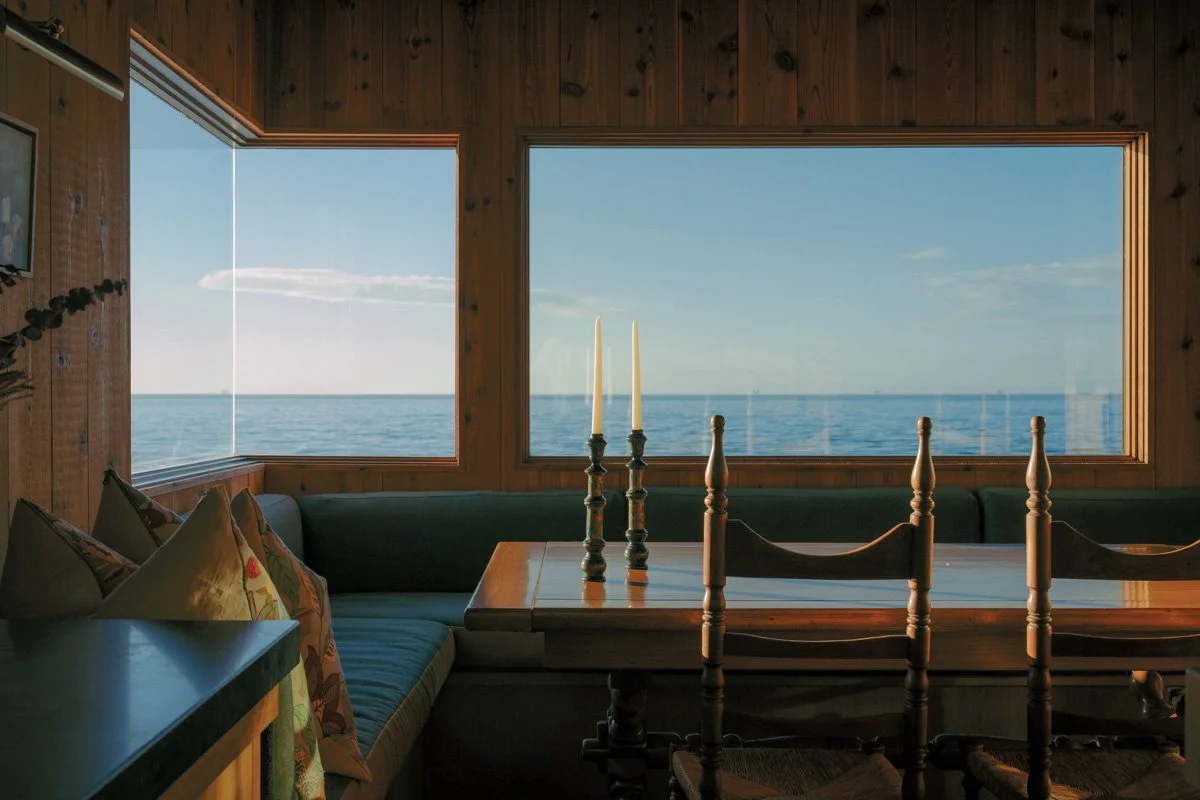
The reclaimed kitchen table was refinished by Danis Painting and panes by Lincoln Windows were installed by Bottenfield
Knapp was similarly bedazzled upon finding the location. “It’s basically a boat on the water at that point, with your proximity,” he says. As for the remodeling, “We just wanted to stay true to what the original vision was and bring it into today but try hard not to lose what makes it so unique and special.”
Knapp was keen on “keeping a sense of place. With the globalization of design,” he says, “so many things look similar. It’s nice to have something that’s unique and textural. You can feel the tile, the wall, the surfaces—all very tactile.” That scene-stealing view, amply showcased from the bedrooms and especially the redone kitchen, with its large corner-angled panes, blends in with strong ambience of ‘70s design—right down to the bright orange plastic chairs on the deck.
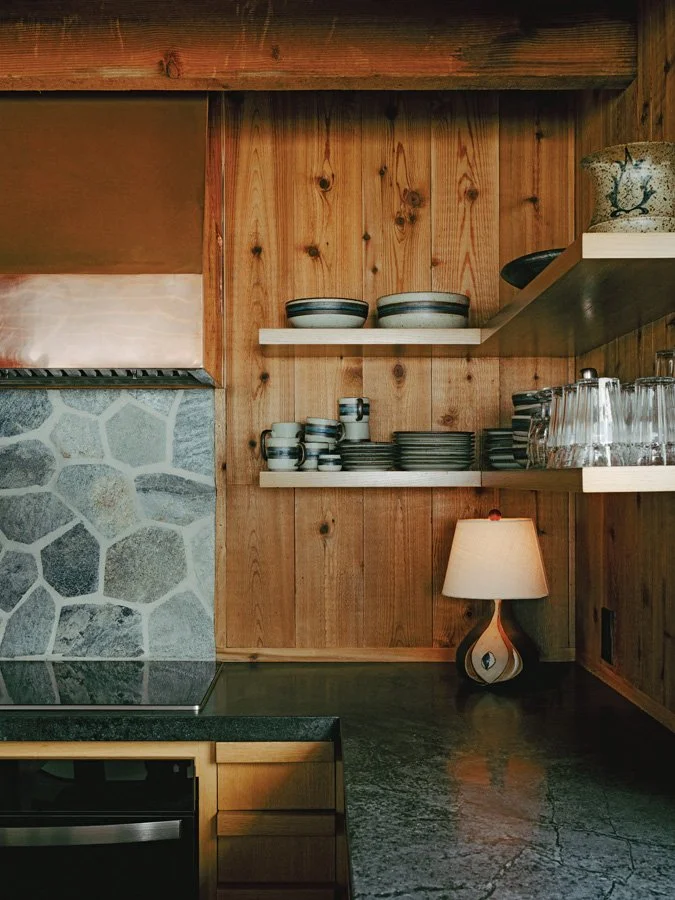
A custom copper hood, shelves of reclaimed oak by Valley Millwork, and soapstone counters add luster
The renovation took about a half year and was realized through the efforts of architect Ryan Brockett, contractor Jordan Bottenfield, and designer Amanda Chappell. Knapp points out that Kruger was no doubt “inspired by the Sea Ranch school of architecture. It is very typical to that style, with the open second story, the vertical cedar siding, the shingled exterior. And as with Sea Ranch, for the most part, it is designed as a weekend home or for fun or peace, not for a primary residence.”
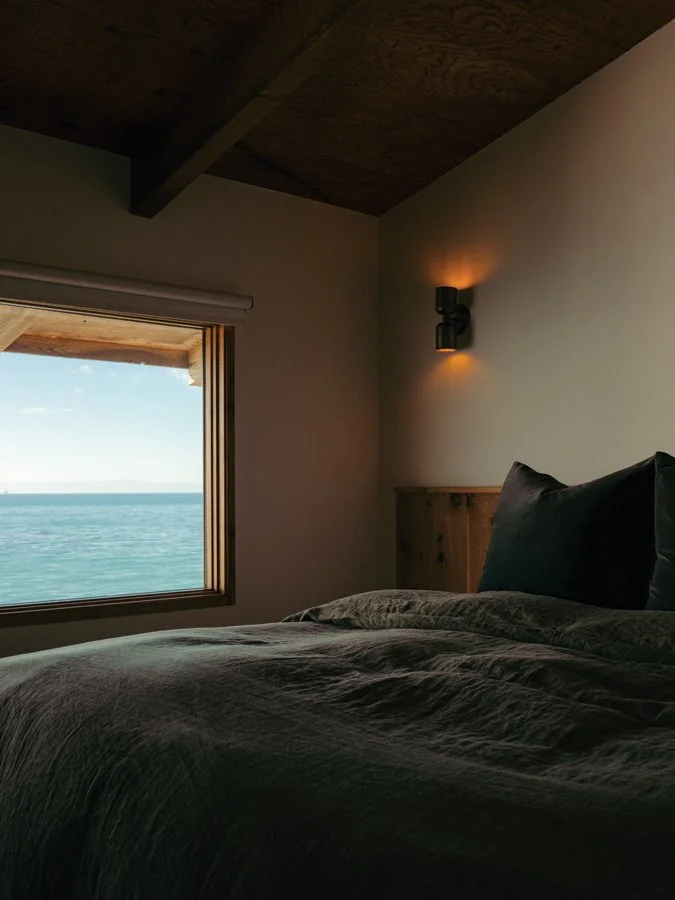
The upstairs bedroom is small but inviting
On a blue-sky late February afternoon—an ideal crystalline atmosphere in which to appreciate the beauty of the Pacific seemingly a stone’s throw away—Bottenfield gives me a short tour of the place. “My wife was in here,” he says, “and she said she almost felt like she was getting a little seasick. It’s like you’re on the water.” In the primary bedroom upstairs, with the huge window showcasing the ocean outside, Bottenfield says, “It feels like you’re looking at a picture. It’s hard to feel the reality, a little bit.”
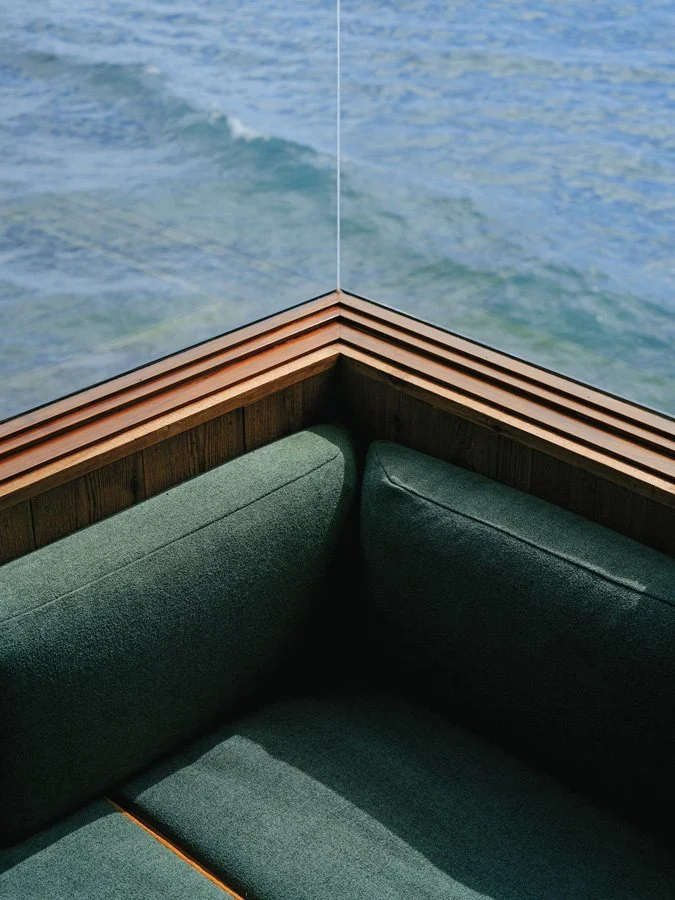
The kitchen corner has custom bench seating
The project included new windows, kitchen cabinets, cushions, and a couch, but Bottenfield says “pretty much everything that could be preserved was preserved. We couldn’t preserve the original tile, but we found a very similar style. We tried not to change anything stylistically. We wanted to keep it true to what it was.”
He adds, “It’s rare to do a project like this. Usually, projects are more modern, or more Spanish in town, compared to a project like this [with a] ‘70s mystique. It takes a bit of an adventurous mindset. That was [Knapp’s] goal. They wanted to kind of have fun, protect the architecture from the original, and use it the same way that he used it.”
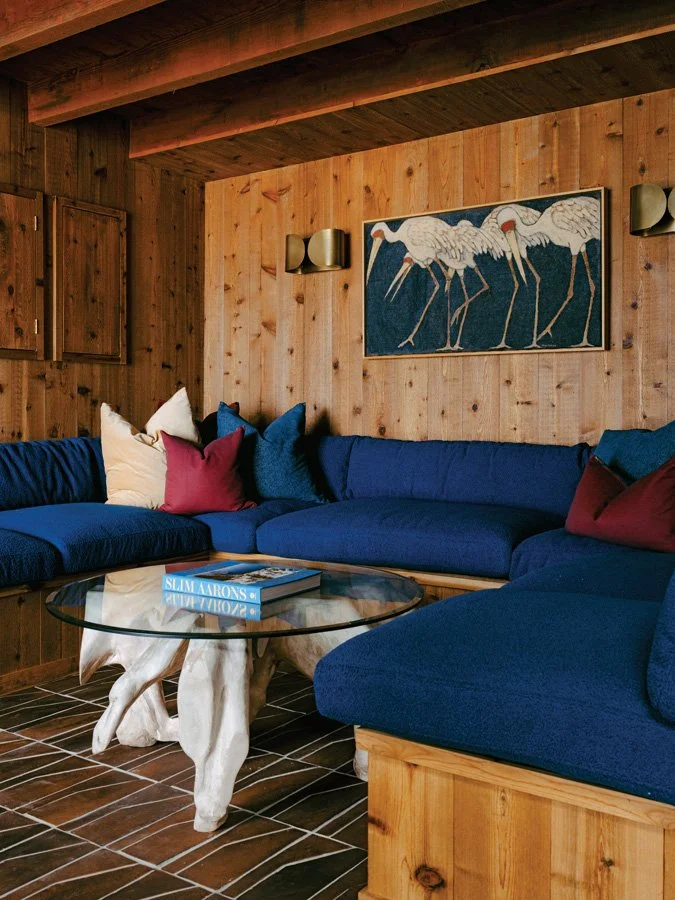
In a sitting arrangement that maximizes the ocean view, the wraparound couch is designed by Bottenfield, with new cushions in a vintage frame
The structure’s status as a distinctive slice of life in the architectural fabric of the area can’t be denied. Kruger, a Santa Barbara native AIA Fellow who founded Santa Barbara’s AIA architectural archives and was part of Kruger Bensen Ziemer (KBZ) Architects, had an impact on the area’s profile. His own Riviera home, built in 1961, is a historic landmark.
His son Eric has strong memories of the Summerland retreat house. He points out that his father secured the permits just two weeks before Coastal Commission restrictions set in, which would make such a project impossible.
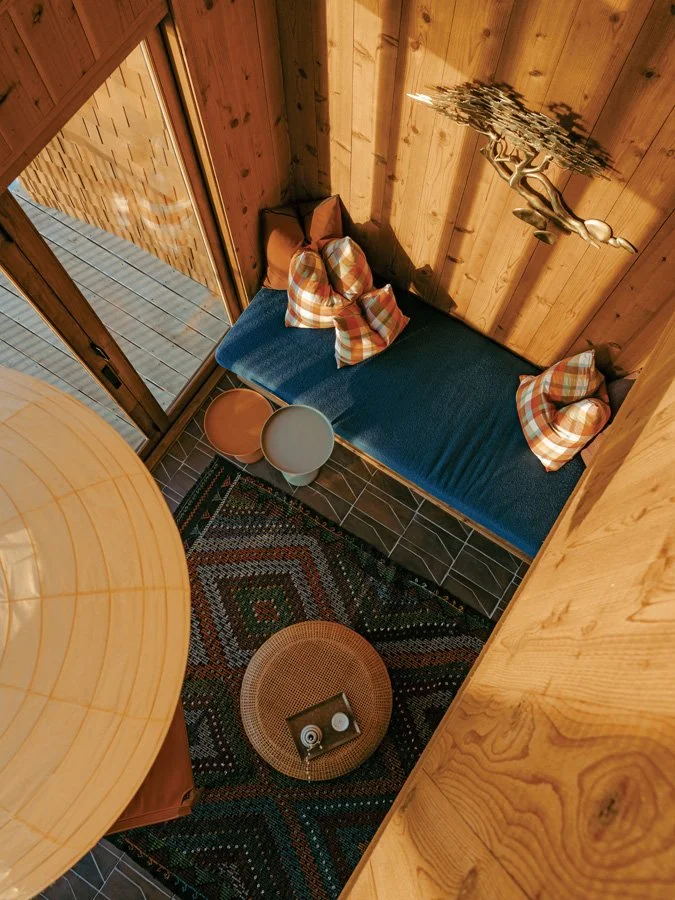
A nook in the downstairs living room space features an Akari spherical lantern light overhead and the warm touch of blue custom couch fabrics by Sunbrella.
“For my family,” says Eric, whose brother, David, is a contractor in town, “it was a gathering place for celebrations, like birthdays and those kinds of events. I think back fondly as it being a kind of a sanctuary my dad created.”
The design is something of a departure from much of the elder Kruger’s work “because my dad was very much of the international and Frank Lloyd Wright school,” Eric says. “The roof doesn’t conform to that—it’s more pitched. It feels Scandinavian, or like a Swiss chalet or a sea lodge. My cousins all called it the ‘beach cabin’ because of the wood. There are so many wood built-ins, which conforms to the midcentury style. There are a lot of handleless doors, like in the medicine cabinets.
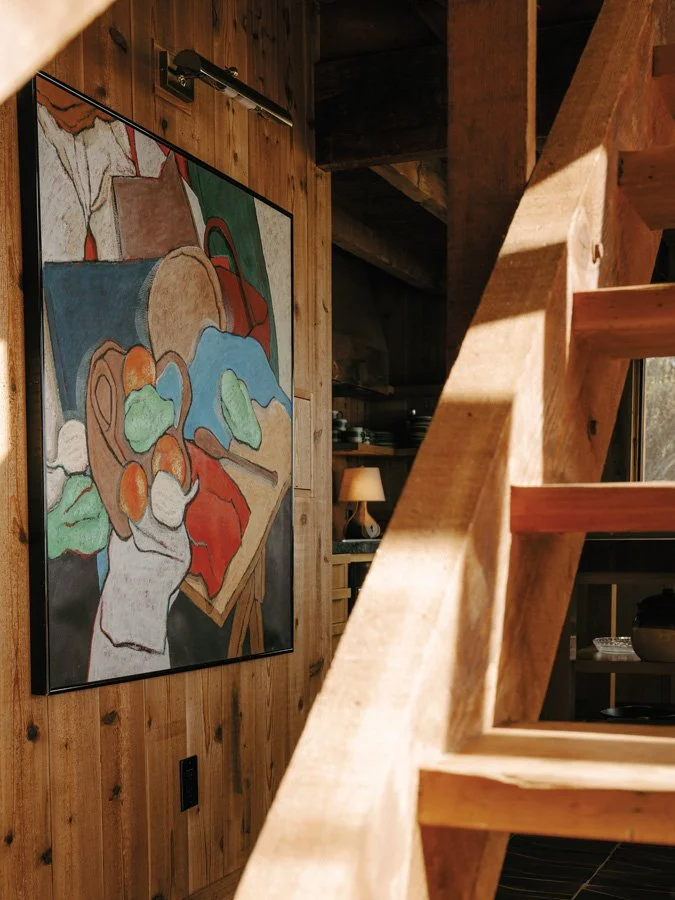
A detail of the wood-lined living room intersecting with a staircase leading to the second floor, with color provided by an organic abstract painting.
“And there are a lot of hidden compartments. Playing hide-and-go-seek as a child in that house was like a dream. There were just endless places to hide,” he says. For Knapp, the renovated house is mostly used “with family, birthdays, hanging out, friends going the beach—a lot of time with friends and family, basically. We’ll probably do some rentals on it. We don’t have enough time to use it, and it’s definitely a special place that we like to share with people.”
And do first-time visitors generally have a bedazzled response?
“I don’t think I’ve ever seen someone walk in and not be, ‘Wow!’ ” Knapp says. “Anyone who walks through the door can tell it’s a super unique and special property.”